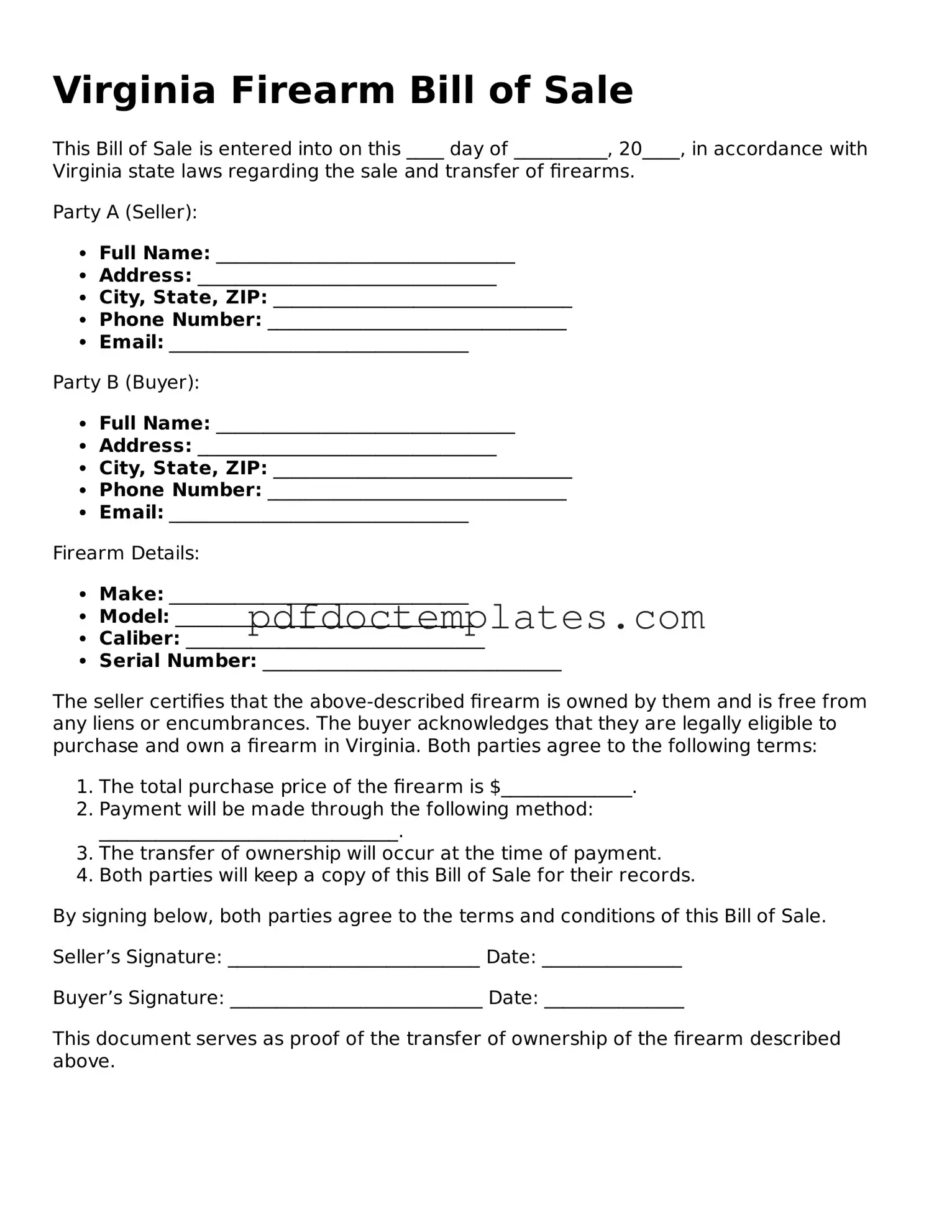
Blank Firearm Bill of Sale Document for Virginia
Misconceptions
Misconceptions about the Virginia Firearm Bill of Sale form can lead to confusion for both buyers and sellers. Here are four common misunderstandings:
- It is mandatory to use the Bill of Sale form for all firearm transactions. Many believe that the Bill of Sale is required for every sale. In Virginia, while it is recommended for documentation purposes, it is not legally required for private sales between individuals.
- Using the Bill of Sale form guarantees a legal sale. Some think that simply filling out the form ensures compliance with all laws. However, both parties must still ensure they are following all applicable state and federal laws regarding firearm sales.
- The Bill of Sale protects the seller from liability. Many sellers assume that using the form absolves them of all responsibility after the sale. This is not entirely true. Sellers can still be held liable if the firearm is used in a crime, especially if they knew the buyer was prohibited from owning a firearm.
- The form is only necessary for handguns. A common belief is that the Bill of Sale is only relevant for handgun transactions. In reality, it can be used for any type of firearm, including rifles and shotguns, to document the sale.
Form Properties
| Fact Name | Description |
|---|---|
| Purpose | The Virginia Firearm Bill of Sale form is used to document the sale or transfer of firearms between private parties. |
| Governing Law | The sale of firearms in Virginia is governed by Virginia Code § 18.2-308.2:2. |
| Parties Involved | The form requires information from both the seller and the buyer, ensuring clarity in the transaction. |
| Identification Requirements | Both parties must provide valid identification, typically a government-issued ID, to verify their identities. |
| Record Keeping | It is recommended that both the seller and buyer retain a copy of the completed Bill of Sale for their records. |
| Firearm Details | The form must include specific details about the firearm, such as make, model, caliber, and serial number. |
| Legal Age | Both parties must be at least 18 years old to legally engage in a private firearm sale in Virginia. |
| Transfer Restrictions | Certain individuals, such as felons or those with restraining orders, are prohibited from purchasing firearms in Virginia. |
Key takeaways
When engaging in the sale or transfer of firearms in Virginia, it is crucial to understand the significance of the Firearm Bill of Sale form. Below are key takeaways that can help ensure a smooth and compliant transaction.
- Documentation is Essential: Always complete a Firearm Bill of Sale to document the transaction. This serves as proof of sale and can protect both the buyer and the seller in case of future disputes.
- Accurate Information Matters: Fill out the form with accurate details, including the names, addresses, and identification numbers of both parties. This information is vital for legal verification and accountability.
- Understand State Laws: Familiarize yourself with Virginia's firearm laws. Certain regulations may affect the sale or transfer, such as background checks or eligibility requirements for buyers.
- Keep Copies: After completing the form, both the buyer and seller should retain copies. This ensures that both parties have access to the agreement should any issues arise later.
Dos and Don'ts
When filling out the Virginia Firearm Bill of Sale form, it's important to follow certain guidelines to ensure the process goes smoothly. Here’s a list of things you should and shouldn’t do:
- Do provide accurate information about the firearm, including make, model, and serial number.
- Do include the full names and addresses of both the buyer and seller.
- Do ensure that both parties sign and date the form.
- Do keep a copy of the completed bill of sale for your records.
- Do verify that the buyer is legally allowed to purchase a firearm.
- Don't leave any fields blank; all information should be filled out completely.
- Don't use nicknames or abbreviations for names; use legal names only.
- Don't forget to check the local laws regarding firearm sales, as they may vary.
- Don't rush through the process; take your time to ensure everything is correct.
Common mistakes
-
Incomplete Information: Many individuals fail to provide all required details. This includes the names, addresses, and signatures of both the buyer and seller. Omitting any of this information can lead to complications later.
-
Incorrect Firearm Details: It's crucial to accurately describe the firearm being sold. Mistakes in the make, model, or serial number can create legal issues. Double-checking these details is essential for a valid transaction.
-
Not Notarizing the Document: While notarization may not always be required, failing to have the document notarized can weaken its validity. A notarized bill of sale adds an extra layer of protection for both parties.
-
Ignoring Local Laws: Each locality may have specific regulations regarding firearm sales. Ignoring these laws can result in penalties. Always research and comply with local requirements before completing the sale.
What You Should Know About This Form
-
What is a Virginia Firearm Bill of Sale form?
A Virginia Firearm Bill of Sale form is a document that records the sale or transfer of a firearm between two parties. This form serves as proof of the transaction, detailing important information about the firearm, the seller, and the buyer. It can be beneficial for both parties, providing a clear record that can help prevent future disputes or legal issues related to the firearm.
-
Is a Bill of Sale required in Virginia when selling a firearm?
While Virginia law does not mandate that a Bill of Sale be created for every private sale of a firearm, having one is highly recommended. This document can protect both the buyer and the seller by providing a written record of the transaction. It can also be useful for proving ownership in the future, should any questions arise regarding the firearm.
-
What information should be included in the Bill of Sale?
A comprehensive Bill of Sale should include several key details:
- The names and addresses of both the buyer and seller
- A description of the firearm, including the make, model, caliber, and serial number
- The date of the transaction
- The purchase price
- Signatures of both parties
Including this information helps ensure clarity and can be beneficial if any legal questions arise later on.
-
Do I need to have the Bill of Sale notarized?
No, notarization is not a requirement for a Bill of Sale in Virginia. However, having it notarized can add an extra layer of authenticity and may provide additional peace of mind for both parties. If you choose to have it notarized, make sure both the buyer and seller are present during the notarization process.
Virginia Firearm Bill of Sale Example
Virginia Firearm Bill of Sale
This Bill of Sale is entered into on this ____ day of __________, 20____, in accordance with Virginia state laws regarding the sale and transfer of firearms.
Party A (Seller):
- Full Name: ________________________________
- Address: ________________________________
- City, State, ZIP: ________________________________
- Phone Number: ________________________________
- Email: ________________________________
Party B (Buyer):
- Full Name: ________________________________
- Address: ________________________________
- City, State, ZIP: ________________________________
- Phone Number: ________________________________
- Email: ________________________________
Firearm Details:
- Make: ________________________________
- Model: ________________________________
- Caliber: ________________________________
- Serial Number: ________________________________
The seller certifies that the above-described firearm is owned by them and is free from any liens or encumbrances. The buyer acknowledges that they are legally eligible to purchase and own a firearm in Virginia. Both parties agree to the following terms:
- The total purchase price of the firearm is $______________.
- Payment will be made through the following method: ________________________________.
- The transfer of ownership will occur at the time of payment.
- Both parties will keep a copy of this Bill of Sale for their records.
By signing below, both parties agree to the terms and conditions of this Bill of Sale.
Seller’s Signature: ___________________________ Date: _______________
Buyer’s Signature: ___________________________ Date: _______________
This document serves as proof of the transfer of ownership of the firearm described above.
Check out Other Common Firearm Bill of Sale Templates for US States
Firearm Bill of Sale Tn - Some forms require a witness signature for added layer of legitimacy.
Understanding the eviction process is essential for both landlords and tenants, particularly in Florida where legal procedures must be followed carefully. The Florida Notice to Quit form is a crucial document that landlords utilize to communicate to tenants about lease violations or to inform them that their tenancy may not continue. Providing clarity and opportunity to rectify the situation, this form is an important starting point. For more detailed information and additional resources, landlords can refer to All Florida Forms.
How to Write a Bill of Sale for a Gun - Acts as a written agreement between two parties regarding the sale.
Michigan Firearm Bill of Sale Form - Essential in states with strict firearm regulations.
Az Firearm Bill of Sale - This form may be required in some jurisdictions for legal firearm transfers.