Printable Motorcycle Bill of Sale Template
Motorcycle Bill of Sale - Customized for State
Misconceptions
When it comes to the Motorcycle Bill of Sale form, several misconceptions can lead to confusion. Understanding the truth behind these myths is essential for both buyers and sellers.
- Misconception 1: A Bill of Sale is not necessary for motorcycle transactions.
- Misconception 2: The Bill of Sale must be notarized.
- Misconception 3: The Bill of Sale is only for used motorcycles.
- Misconception 4: A Bill of Sale guarantees a clear title.
- Misconception 5: You can use any template for the Bill of Sale.
Many believe that a Bill of Sale is optional. However, it serves as a crucial record of the transaction, protecting both parties by documenting the sale details.
Some think that notarization is a requirement for the Bill of Sale to be valid. In most states, notarization is not necessary, although it can add an extra layer of security.
This form is often associated with used vehicles, but it is equally important for new motorcycle purchases. It provides proof of ownership, regardless of the motorcycle's age.
While the Bill of Sale documents the sale, it does not guarantee that the seller has a clear title. Buyers should always verify the title status before completing the transaction.
Using a generic template may lead to missing important information. It is advisable to use a specific Motorcycle Bill of Sale template that includes all necessary details for your state.
Form Properties
| Fact Name | Description |
|---|---|
| Purpose | The Motorcycle Bill of Sale form serves as a legal document that records the sale of a motorcycle between a buyer and a seller. |
| Identification | This form typically includes details such as the motorcycle's make, model, year, and Vehicle Identification Number (VIN) to clearly identify the vehicle being sold. |
| Consideration | The document should state the purchase price agreed upon by both parties, which is essential for the transaction's validity. |
| Signatures | Both the buyer and seller must sign the form to confirm the agreement and the transfer of ownership. |
| State-Specific Laws | Each state has its own laws governing the sale of vehicles, including motorcycles. For example, in California, the form must comply with the California Vehicle Code Section 5901. |
| Record Keeping | It is advisable for both parties to keep a copy of the signed Bill of Sale for their records, as it can serve as proof of ownership and sale in the future. |
Key takeaways
When filling out and using a Motorcycle Bill of Sale form, there are several important points to keep in mind. These takeaways will help ensure the process goes smoothly and protects both the buyer and seller.
- Complete Information: Make sure to include all necessary details about the motorcycle, such as the make, model, year, VIN (Vehicle Identification Number), and any additional features.
- Seller and Buyer Details: Clearly list the full names and addresses of both the seller and the buyer. This information is crucial for legal purposes.
- Purchase Price: State the agreed-upon price for the motorcycle. This amount should reflect the actual sale price to avoid any future disputes.
- Date of Sale: Include the date when the transaction takes place. This helps establish the timeline for ownership transfer.
- As-Is Condition: Indicate whether the motorcycle is sold "as-is." This means the buyer accepts the motorcycle in its current condition without warranties.
- Signatures Required: Both parties must sign the document. This signature confirms that both the buyer and seller agree to the terms outlined in the bill of sale.
- Keep Copies: After the form is completed and signed, make copies for both the buyer and seller. Having a record of the transaction is important for both parties.
- Check State Requirements: Be aware that some states may have specific requirements for a bill of sale. Research local laws to ensure compliance.
By following these key takeaways, you can create a clear and effective Motorcycle Bill of Sale that serves both parties well.
Dos and Don'ts
When filling out a Motorcycle Bill of Sale form, it is important to be thorough and accurate. Here is a list of things you should and shouldn't do:
- Do ensure that all information is accurate, including the motorcycle's make, model, year, and VIN.
- Do include the purchase price clearly to avoid any confusion.
- Do provide both the seller's and buyer's names and addresses.
- Do sign and date the form to validate the transaction.
- Do keep a copy of the completed Bill of Sale for your records.
- Don't leave any fields blank; fill out all required sections.
- Don't use white-out or erase any mistakes; instead, cross out errors and initial them.
- Don't rush through the process; take your time to ensure accuracy.
- Don't forget to check local requirements, as they may vary by state.
- Don't use vague language; be specific about the terms of the sale.
Common mistakes
-
Failing to include the date of sale. This is crucial for establishing the timeline of ownership.
-
Not providing the VIN (Vehicle Identification Number). The VIN uniquely identifies the motorcycle and is necessary for registration.
-
Omitting the purchase price. This information is important for both parties and for tax purposes.
-
Leaving out the seller's and buyer's information. Full names and addresses should be clearly stated to avoid confusion.
-
Not including a description of the motorcycle. Details such as make, model, year, and color help in identifying the vehicle.
-
Neglecting to have both parties sign the document. Signatures are essential to validate the agreement.
-
Using incorrect or incomplete payment details. Specify how the payment will be made to avoid misunderstandings.
-
Failing to provide witness signatures if required by state law. Some states may mandate a witness for the transaction.
-
Not keeping a copy of the bill of sale. Both parties should retain a signed copy for their records.
What You Should Know About This Form
-
What is a Motorcycle Bill of Sale?
A Motorcycle Bill of Sale is a legal document that serves as proof of the sale of a motorcycle between a buyer and a seller. This document includes essential details such as the motorcycle's make, model, year, Vehicle Identification Number (VIN), sale price, and the names and addresses of both parties involved. It protects both the buyer and seller by documenting the transaction and can be used for registration purposes with the Department of Motor Vehicles (DMV).
-
Why do I need a Motorcycle Bill of Sale?
Having a Motorcycle Bill of Sale is crucial for several reasons. Firstly, it provides legal evidence of the transaction, which can be important if any disputes arise in the future. Secondly, it helps the buyer establish ownership and facilitates the registration process with the DMV. Lastly, it can protect the seller from any potential claims related to the motorcycle after the sale, such as accidents or unpaid tickets.
-
What information should be included in the Motorcycle Bill of Sale?
A comprehensive Motorcycle Bill of Sale should include the following information:
- The full names and addresses of both the buyer and seller
- The motorcycle's make, model, year, and VIN
- The sale price and payment method
- The date of the sale
- Any conditions or warranties (if applicable)
- Signatures of both parties
Including all of this information ensures that the document is complete and legally binding.
-
Do I need to have the Motorcycle Bill of Sale notarized?
In most cases, a Motorcycle Bill of Sale does not need to be notarized to be valid. However, some states may have specific requirements regarding notarization, especially if the motorcycle is being registered or if there are any liens involved. It is always a good idea to check your state’s regulations or consult with a local DMV office to ensure compliance with any applicable laws.
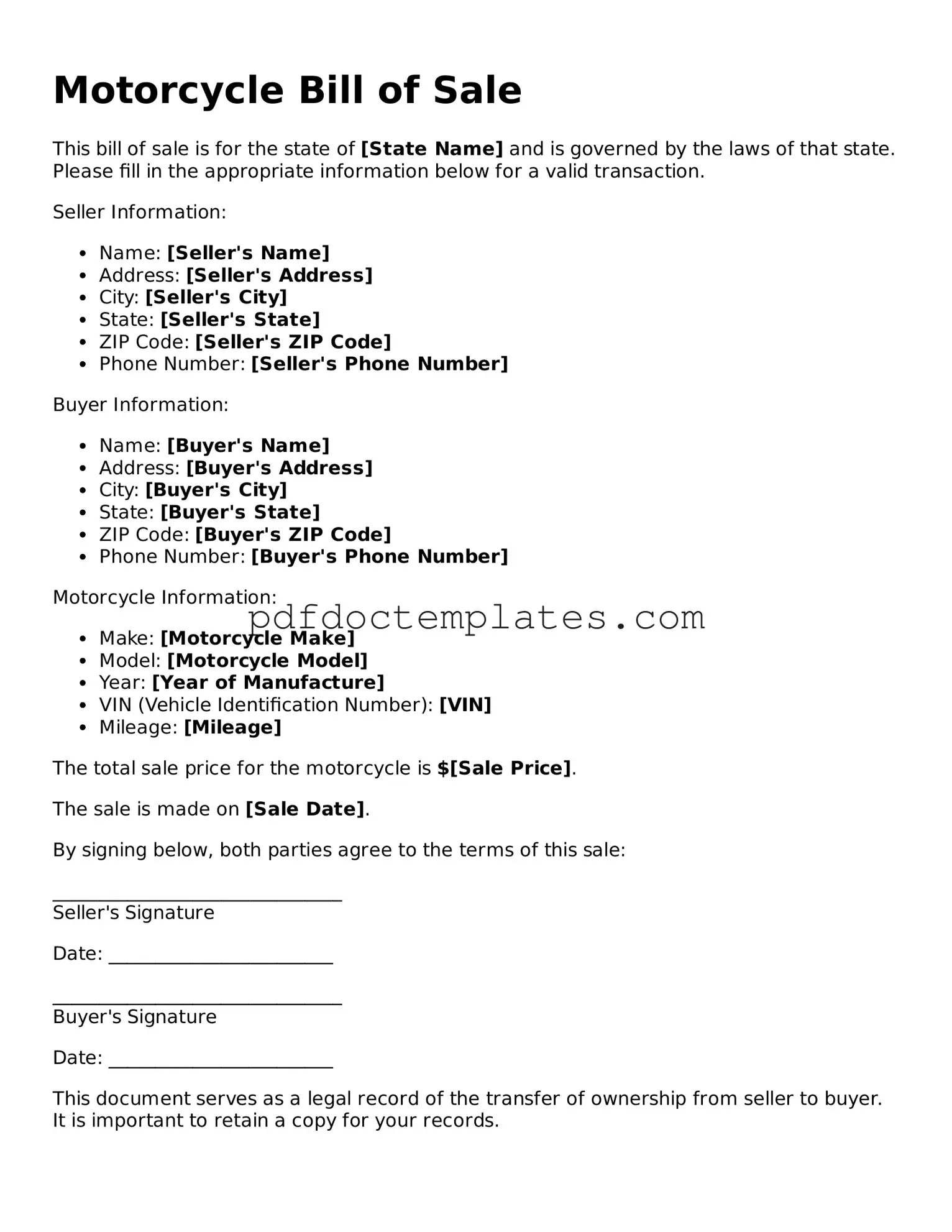
Motorcycle Bill of Sale Example
Motorcycle Bill of Sale
This bill of sale is for the state of [State Name] and is governed by the laws of that state. Please fill in the appropriate information below for a valid transaction.
Seller Information:
- Name: [Seller's Name]
- Address: [Seller's Address]
- City: [Seller's City]
- State: [Seller's State]
- ZIP Code: [Seller's ZIP Code]
- Phone Number: [Seller's Phone Number]
Buyer Information:
- Name: [Buyer's Name]
- Address: [Buyer's Address]
- City: [Buyer's City]
- State: [Buyer's State]
- ZIP Code: [Buyer's ZIP Code]
- Phone Number: [Buyer's Phone Number]
Motorcycle Information:
- Make: [Motorcycle Make]
- Model: [Motorcycle Model]
- Year: [Year of Manufacture]
- VIN (Vehicle Identification Number): [VIN]
- Mileage: [Mileage]
The total sale price for the motorcycle is $[Sale Price].
The sale is made on [Sale Date].
By signing below, both parties agree to the terms of this sale:
_______________________________
Seller's Signature
Date: ________________________
_______________________________
Buyer's Signature
Date: ________________________
This document serves as a legal record of the transfer of ownership from seller to buyer. It is important to retain a copy for your records.
Different Types of Motorcycle Bill of Sale Forms:
Rv Bill of Sale Printable - May involve a notary if either party requests additional verification.
The New York Operating Agreement form is essential for limited liability companies (LLCs) operating in New York State, as it delineates the financial and functional decisions of the business. By establishing rules, regulations, and provisions, this document is crucial for defining the internal structure of the company and outlining member responsibilities while protecting their personal assets from business liabilities. Moreover, the Operating Agreement plays a significant role in providing a framework for smooth operations and resolving disputes, ensuring that all members align with the governance and operational strategies of the company. For those looking to draft this important document, resources such as All New York Forms can be invaluable.