Download Employee Status Change Template
Misconceptions
Understanding the Employee Status Change form is crucial for both employers and employees. However, several misconceptions often arise regarding its purpose and use. Here are four common misconceptions:
- Misconception 1: The form is only for terminations.
- Misconception 2: Only HR can submit the form.
- Misconception 3: The form is optional.
- Misconception 4: The form has no impact on employee benefits.
This is incorrect. While the form is used to document terminations, it also applies to other changes such as promotions, demotions, and changes in job titles or responsibilities.
In reality, while HR typically processes the form, any authorized manager or supervisor can initiate the submission. This ensures that all relevant changes are documented promptly.
This is a misunderstanding. Completing the Employee Status Change form is often mandatory for maintaining accurate employee records and ensuring compliance with company policies.
This is not true. Changes documented on the form can affect various employee benefits, including health insurance and retirement plans. It is essential to review these changes carefully.
File Details
| Fact Name | Description |
|---|---|
| Purpose | The Employee Status Change form is used to document changes in an employee's status, such as promotions, transfers, or terminations. |
| Who Uses It | This form is typically utilized by HR departments to ensure accurate record-keeping and compliance with company policies. |
| Information Required | Commonly, the form requires details such as the employee's name, ID number, current position, and new status. |
| Submission Process | Employees or managers must submit the completed form to the HR department for processing and approval. |
| State-Specific Forms | Some states may require specific forms or additional documentation based on local labor laws. |
| Governing Laws | In states like California, the California Labor Code governs the documentation of employee status changes. |
| Record Keeping | Employers are required to maintain these forms as part of their employee records for a specified duration. |
| Impact on Benefits | Changes in employee status may affect eligibility for benefits, so it’s crucial to process the form promptly. |
Key takeaways
When filling out and using the Employee Status Change form, there are several important points to consider. Understanding these key takeaways can help ensure a smooth process.
- Accuracy is essential. Ensure that all information provided on the form is correct. Mistakes can lead to delays or complications in processing the change.
- Timeliness matters. Submit the form promptly to avoid disruptions in payroll or benefits. Delays in submission can affect your employment status and related benefits.
- Know the required approvals. Familiarize yourself with who needs to approve the form before submission. This may include supervisors or HR personnel.
- Keep a copy for your records. After submitting the form, retain a copy for your personal records. This can be useful for future reference or if any issues arise.
- Follow up if necessary. If you do not receive confirmation of the change within a reasonable time, reach out to HR for clarification. Communication is key to ensuring your status is updated correctly.
Dos and Don'ts
When filling out the Employee Status Change form, it is important to be mindful of certain practices to ensure accuracy and compliance. Here are five things you should and shouldn't do:
- Do: Review the form carefully before starting to fill it out.
- Do: Provide accurate and up-to-date information.
- Do: Use clear and concise language.
- Do: Double-check for any required signatures or approvals.
- Do: Submit the form promptly to avoid delays.
- Don't: Leave any sections blank unless instructed.
- Don't: Use abbreviations or jargon that may not be understood.
- Don't: Alter the form's layout or structure.
- Don't: Forget to keep a copy for your records.
- Don't: Submit the form without verifying all details are correct.
Common mistakes
-
Incomplete Information: Many individuals forget to fill out all required fields. This can lead to delays in processing the form. Always double-check to ensure every section is completed.
-
Incorrect Dates: Entering the wrong effective date for the status change can cause confusion. Make sure to verify the dates before submitting the form.
-
Failure to Sign: Some people neglect to sign the form. A signature is often required to validate the request. Remember, your signature is an acknowledgment of the changes being made.
-
Not Updating Contact Information: If personal contact details have changed, such as phone numbers or addresses, these should be updated on the form. Accurate contact information is crucial for communication.
-
Ignoring Supervisor Notification: Failing to inform a direct supervisor about the change can lead to misunderstandings. It’s important to communicate with your supervisor prior to submitting the form.
-
Neglecting to Review Company Policies: Some individuals overlook the relevant company policies regarding status changes. Familiarize yourself with these policies to ensure compliance and avoid complications.
-
Submitting Late: Timing is essential. Delaying the submission of the form can result in missed deadlines or issues with payroll. Aim to submit the form as soon as a change is anticipated.
What You Should Know About This Form
-
What is the purpose of the Employee Status Change form?
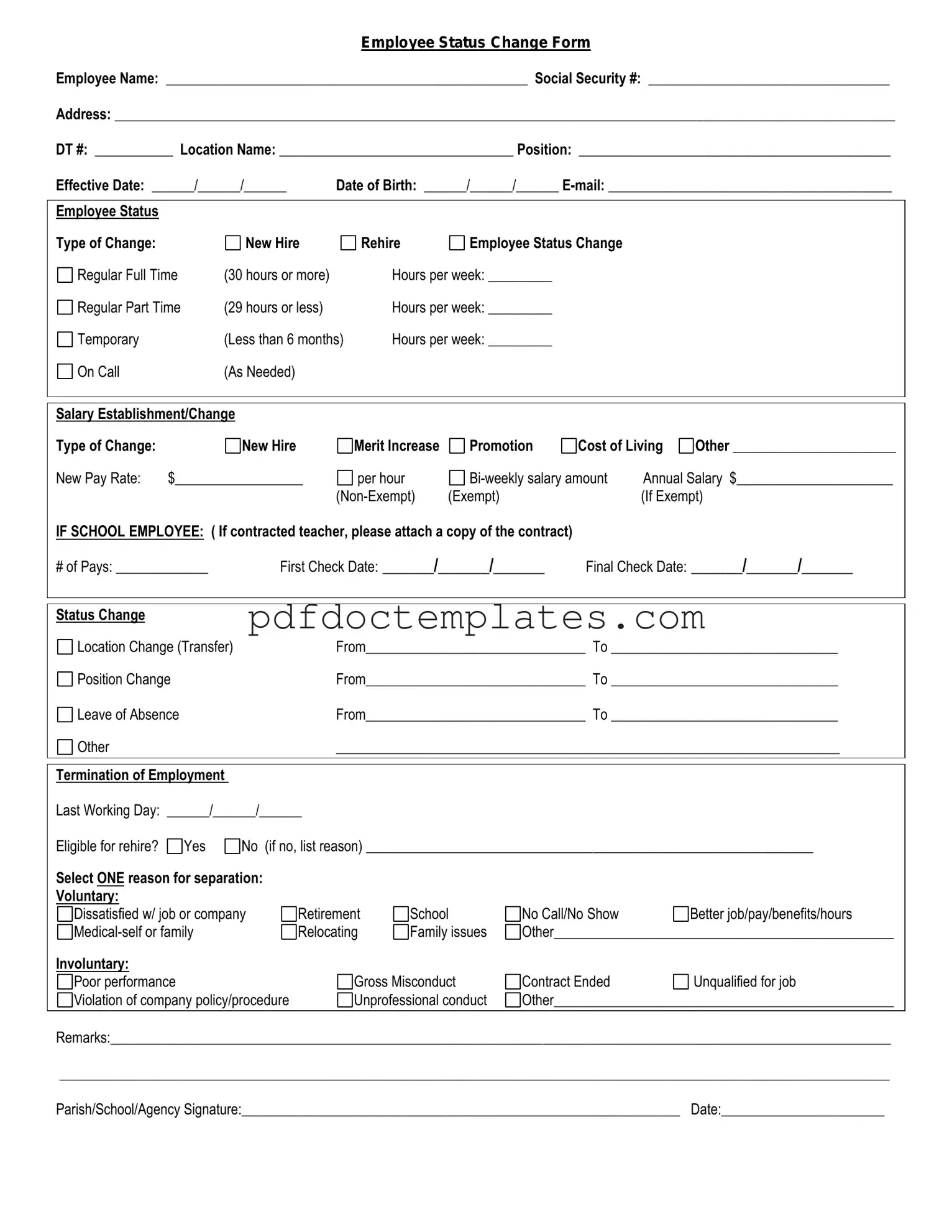
The Employee Status Change form is used to document any changes in an employee's status within the organization. This includes changes such as promotions, demotions, transfers, terminations, or changes in employment status (e.g., full-time to part-time). Proper documentation ensures that HR records are up-to-date and helps maintain compliance with company policies.
-
Who needs to fill out the Employee Status Change form?
The form should be completed by the employee's direct supervisor or manager. In some cases, HR may also initiate the form. It is important that the person filling it out has accurate information regarding the employee's current status and the nature of the change.
-
When should the Employee Status Change form be submitted?
The form should be submitted as soon as a change in status is determined. Timely submission is crucial to ensure that payroll and benefits are adjusted accordingly. For example, if an employee is promoted, the form should be submitted before the new pay rate takes effect.
-
What information is required on the form?
The form typically requires the following information:
- Employee's name and ID number
- Current job title and department
- New job title and department (if applicable)
- Reason for the status change
- Effective date of the change
- Signature of the supervisor or manager
Providing complete and accurate information helps facilitate a smooth transition for the employee.
-
Where do I submit the completed form?
Once the form is completed and signed, it should be submitted to the Human Resources department. Depending on your organization’s procedures, this may be done electronically or in person. Check with HR for specific submission guidelines.
Employee Status Change Example

Employee Status Change Form
Employee Name: ___________________________________________________ Social Security #: __________________________________
Address: ______________________________________________________________________________________________________________
DT #: ___________ Location Name: _________________________________ Position: ____________________________________________
Effective Date: ______/______/______ |
Date of Birth: ______/______/______ |
|||
|
|
|
|
|
Employee Status |
|
|
|
|
Type of Change: |
New Hire |
|
Rehire |
Employee Status Change |
Regular Full Time |
(30 hours or more) |
|
Hours per week: _________ |
|
Regular Part Time |
(29 hours or less) |
|
Hours per week: _________ |
|
Temporary |
(Less than 6 months) |
Hours per week: _________ |
||
On Call |
(As Needed) |
|
|
|
|
|
|
|
|
Salary Establishment/Change |
|
|
|
|
|
|
|
|
|
|
Type of Change: |
|
New Hire |
|
Merit Increase |
Promotion |
Cost of Living |
Other _______________________ |
|||
New Pay Rate: |
$__________________ |
per hour |
|
Annual Salary $______________________ |
||||||
|
|
|
|
(Exempt) |
|
|
(If Exempt) |
|||
IF SCHOOL EMPLOYEE: ( If contracted teacher, please attach a copy of the contract) |
|
|
|
|||||||
# of Pays: _____________ |
First Check Date: ______/______/______ |
Final Check Date: ______/______/______ |
||||||||
|
|
|
|
|
|
|
|
|
|
|
|
|
|
|
|
|
|
|
|
|
|
Status Change |
|
|
|
|
|
|
|
|
|
|
Location Change (Transfer) |
|
|
From_______________________________ To ________________________________ |
|||||||
Position Change |
|
|
From_______________________________ To ________________________________ |
|||||||
Leave of Absence |
|
|
From_______________________________ To ________________________________ |
|||||||
Other |
|
|
|
_______________________________________________________________________ |
||||||
|
|
|
|
|
|
|
|
|
|
|
Termination of Employment |
|
|
|
|
|
|
|
|
|
|
Last Working Day: ______/______/______ |
|
|
|
|
|
|
|
|||
Eligible for rehire? |
Yes |
No (if no, list reason) _______________________________________________________________ |
||||||||
Select ONE reason for separation: |
|
|
|
|
|
|
|
|
||
Voluntary: |
|
|
|
|
|
|
|
|
|
|
Dissatisfied w/ job or company |
Retirement |
School |
No Call/No Show |
|
Better job/pay/benefits/hours |
|||||
|
Relocating |
Family issues |
Other________________________________________________ |
|||||||
Involuntary: |
|
|
|
|
|
|
|
|
|
|
Poor performance |
|
|
Gross Misconduct |
Contract Ended |
|
Unqualified for job |
||||
Violation of company policy/procedure |
|
Unprofessional conduct |
Other________________________________________________ |
|||||||
|
|
|
|
|
|
|
|
|
|
|
Remarks:______________________________________________________________________________________________________________
_____________________________________________________________________________________________________________________
Parish/School/Agency Signature:______________________________________________________________ Date:_______________________
Consider More Forms
Western Union Form - Aids in planning financial transactions efficiently.
The completion of a Dirt Bike Bill of Sale form is essential for anyone looking to buy or sell a dirt bike in California, as it provides a clear and legal documentation of the transaction. This form not only helps protect the interests of both parties but also ensures a smooth registration process, safeguarding against future disputes.
Cadet Command Forms - The worksheet is designed for all cadets in the ROTC program.
Medicare Abn - Knowing about potential non-coverage can motivate patients to seek further information.