Download California Death of a Joint Tenant Affidavit Template
Misconceptions
The California Death of a Joint Tenant Affidavit form is often misunderstood. Below are ten common misconceptions about this form, along with clarifications for each.
-
It is only necessary for real estate.
This form is primarily used for real property but can also apply to personal property held in joint tenancy.
-
All joint tenants must sign the affidavit.
Only the surviving joint tenant needs to sign the affidavit to transfer the deceased tenant's interest.
-
The affidavit must be filed with the court.
This form is typically filed with the county recorder's office, not the court.
-
It is the same as a will.
This affidavit is not a substitute for a will. It specifically addresses the transfer of property due to the death of a joint tenant.
-
It can be used for tenants in common.
The affidavit is specifically for joint tenants, not tenants in common, who do not have the right of survivorship.
-
There is a deadline for filing the affidavit.
While it is advisable to file the affidavit promptly, there is no strict deadline imposed by law.
-
The form is only for spouses.
Any individuals holding property in joint tenancy can use this form, not just spouses.
-
It requires a notary public.
A notary public is not required for the affidavit, but notarization can add credibility.
-
Filing the affidavit transfers ownership immediately.
The transfer of ownership is effective upon filing, but it may take time for the county recorder to process the document.
-
It is a complicated process.
The process is straightforward and can often be completed without legal assistance, depending on the complexity of the estate.
File Details
| Fact Name | Description |
|---|---|
| Purpose | The California Death of a Joint Tenant Affidavit is used to transfer ownership of property when one joint tenant passes away. |
| Governing Law | This form is governed by California Probate Code Section 5600 and related statutes. |
| Eligibility | Only joint tenants can use this affidavit; it does not apply to tenants in common. |
| Required Information | The affidavit must include details about the deceased, the property, and the surviving joint tenant. |
| Signature Requirement | The surviving joint tenant must sign the affidavit in front of a notary public. |
| Filing | After completion, the affidavit should be filed with the county recorder's office where the property is located. |
| Effectiveness | This affidavit serves to clear the title of the deceased joint tenant's interest in the property. |
| Documentation | A certified copy of the death certificate is typically required to accompany the affidavit. |
| Legal Advice | While the form is straightforward, consulting a legal professional is recommended to ensure compliance with all requirements. |
Key takeaways
When dealing with the California Death of a Joint Tenant Affidavit form, it’s important to understand several key points to ensure a smooth process.
- Purpose of the Affidavit: This form is used to confirm the death of a joint tenant and facilitates the transfer of property ownership to the surviving joint tenant.
- Required Information: Complete details about the deceased joint tenant, including their name, date of death, and relevant property information, must be provided.
- Signature Requirement: The surviving joint tenant must sign the affidavit. This signature confirms their status as the remaining owner of the property.
- Recording the Affidavit: After filling out the form, it should be recorded with the county recorder's office where the property is located to officially update the property records.
Understanding these key points can help ensure that the process of transferring property ownership is handled efficiently and correctly.
Dos and Don'ts
When filling out the California Death of a Joint Tenant Affidavit form, it's important to follow certain guidelines to ensure accuracy and compliance. Here are some dos and don'ts to keep in mind:
- Do provide accurate information about the deceased joint tenant.
- Do include the date of death and any relevant property details.
- Don't leave any sections blank; fill in all required fields.
- Don't forget to sign and date the affidavit before submission.
Common mistakes
-
Incorrect Information: One of the most common mistakes is providing inaccurate details about the deceased joint tenant. This includes misspelling names, incorrect dates of birth, or wrong property descriptions. Such errors can lead to complications in the transfer of property ownership.
-
Failure to Sign: Some individuals neglect to sign the affidavit. Without a signature, the document is not valid, and the intended transfer of property cannot proceed.
-
Omitting Required Documentation: Often, people forget to include necessary supporting documents, such as a copy of the death certificate. This omission can delay the process or result in rejection of the affidavit.
-
Not Notarizing the Affidavit: A common oversight is failing to have the affidavit notarized. Most jurisdictions require notarization to verify the identity of the person submitting the document.
-
Improper Witnesses: Some forms require witnesses to be present during the signing. Failing to have the appropriate number of witnesses, or having witnesses who are not qualified, can invalidate the affidavit.
-
Ignoring State-Specific Requirements: Each state may have specific rules regarding the affidavit. Not being aware of California's particular requirements can lead to significant issues, including delays or rejections.
What You Should Know About This Form
-
What is the California Death of a Joint Tenant Affidavit?
The California Death of a Joint Tenant Affidavit is a legal document used to transfer the interest of a deceased joint tenant in property to the surviving joint tenant(s). This affidavit serves as proof of the death and facilitates the transfer of ownership without the need for probate.
-
Who can file this affidavit?
Only the surviving joint tenant(s) can file the affidavit. They must have been a joint tenant with the deceased at the time of death. It is essential to have the necessary documentation to support the claim.
-
What information is required to complete the affidavit?
The affidavit requires details such as the names of the deceased and surviving joint tenant(s), the date of death, and a legal description of the property. Additionally, a certified copy of the death certificate must be attached.
-
Is there a specific format for the affidavit?
Yes, the affidavit must be completed in a specific format as outlined by California law. It should include all necessary information, be signed by the surviving joint tenant(s), and notarized to ensure its validity.
-
Where should the affidavit be filed?
The completed affidavit should be filed with the county recorder’s office in the county where the property is located. This step is crucial for updating the property records and establishing clear ownership.
-
Are there any fees associated with filing the affidavit?
Yes, there may be filing fees that vary by county. It is advisable to check with the local county recorder’s office for the exact amount and any additional costs that may apply.
-
What happens if there are multiple surviving joint tenants?
If there are multiple surviving joint tenants, all must sign the affidavit. Each individual has an equal right to the property, and their signatures confirm the joint ownership transfer.
-
Can this affidavit be used for all types of property?
The affidavit can be used for various types of property, including real estate and personal property held in joint tenancy. However, it is important to verify that the property is indeed held as joint tenancy before proceeding.
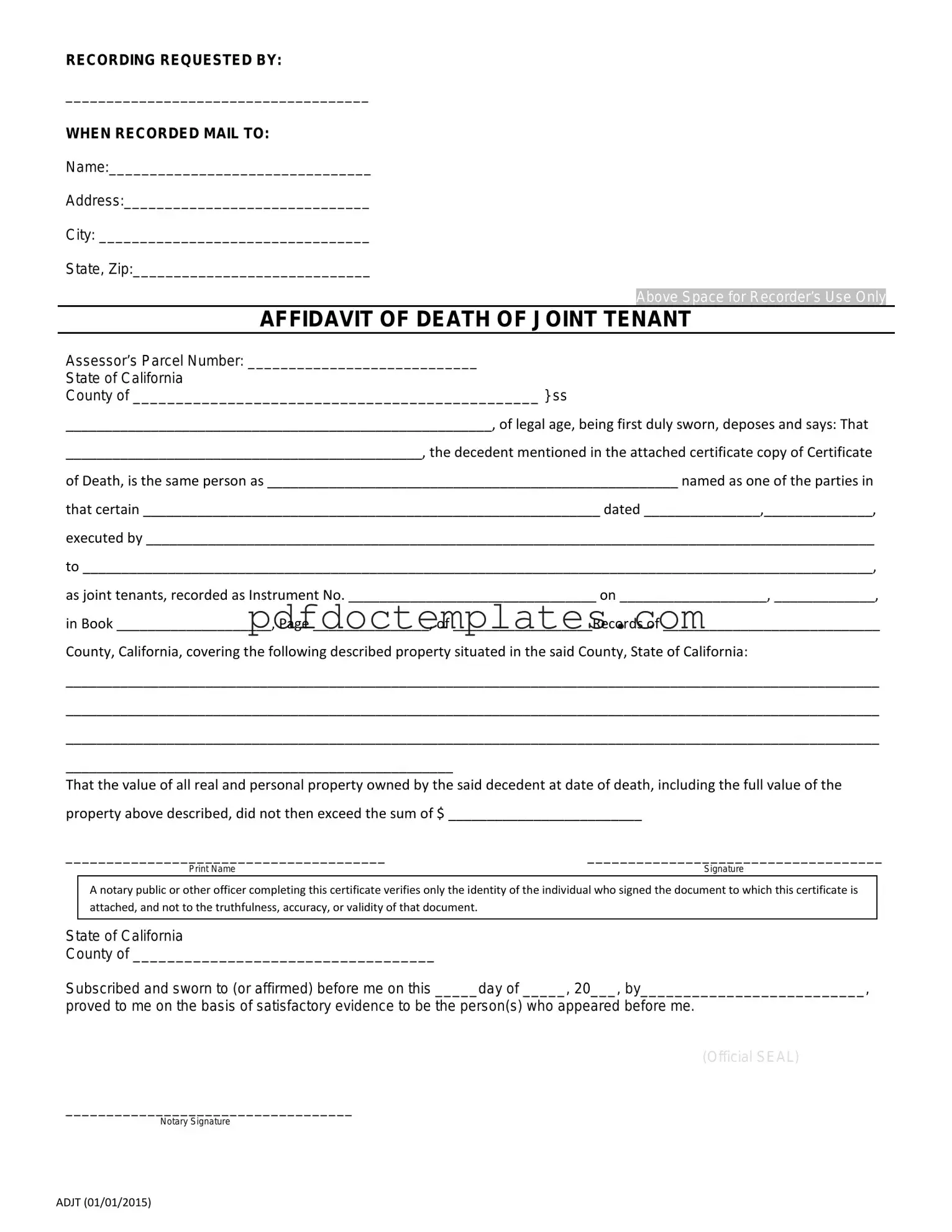
California Death of a Joint Tenant Affidavit Example

RECORDING REQUESTED BY:
_____________________________________
WHEN RECORDED MAIL TO:
Name:________________________________
Address:______________________________
City: _________________________________
State, Zip:_____________________________
Above Space for Recorder’s Use Only
AFFIDAVIT OF DEATH OF JOINT TENANT
Assessor’s Parcel Number: ____________________________
State of California
County of _______________________________________________ } ss
_______________________________________________________, of legal age, being first duly sworn, deposes and says: That
______________________________________________, the decedent mentioned in the attached certificate copy of Certificate
of Death, is the same person as _____________________________________________________ named as one of the parties in
that certain ___________________________________________________________ dated _______________,______________,
executed by ______________________________________________________________________________________________
to ______________________________________________________________________________________________________,
as joint tenants, recorded as Instrument No. ________________________________ on ___________________, _____________,
in Book ____________________, Page _______________, of __________________Records of ____________________________
County, California, covering the following described property situated in the said County, State of California:
_________________________________________________________________________________________________________
_________________________________________________________________________________________________________
_________________________________________________________________________________________________________
__________________________________________________
That the value of all real and personal property owned by the said decedent at date of death, including the full value of the property above described, did not then exceed the sum of $ _________________________
_______________________________________ |
____________________________________ |
Print Name |
Signature |
A notary public or other officer completing this certificate verifies only the identity of the individual who signed the document to which this certificate is attached, and not to the truthfulness, accuracy, or validity of that document.
State of California
County of ___________________________________
Subscribed and sworn to (or affirmed) before me on this _____day of _____, 20___, by__________________________,
proved to me on the basis of satisfactory evidence to be the person(s) who appeared before me.
(Official SEAL)
___________________________________
Notary Signature
ADJT (01/01/2015)
Consider More Forms
Schedule of Availability Template - Let us know about any seasonal availability changes.
In situations where parents are unable to care for their children, the Florida Power of Attorney for a Child form serves as a vital tool, allowing them to appoint another adult to manage their child's needs. This document clarifies the extent of the authority granted, ensuring that the appointed guardian can act effectively and in the best interest of the child. For those looking for assistance with such documents, All Florida Forms provides valuable resources and templates.
State Disability Insurance - Disability Insurance benefits are a crucial safety net for workers in California.